
Universities at the intersection of truth and politics
Examining the Fulnecky/University of Oklahoma crisis: A call to action for academic integrity

The Situation
Three days ago, the University of Oklahoma chapter of Turning Point USA, a national right-wing student organization, posted on X (formerly Twitter) about an incident involving student Samantha Fulnecky and graduate instructor Mel Curth. Fulnecky submitted a psychology essay that, according to Curth, failed to meet the core requirements of the assignment, which was a 650-word reaction to an academic article on gender stereotypes. Fulnecky’s argument relied almost exclusively on personal religious beliefs, did not engage with the source material, and included inflammatory language, such as referring to the acceptance of multiple genders “demonic.”
Turning Point OA helpfully provided the full essay for our evaluation:
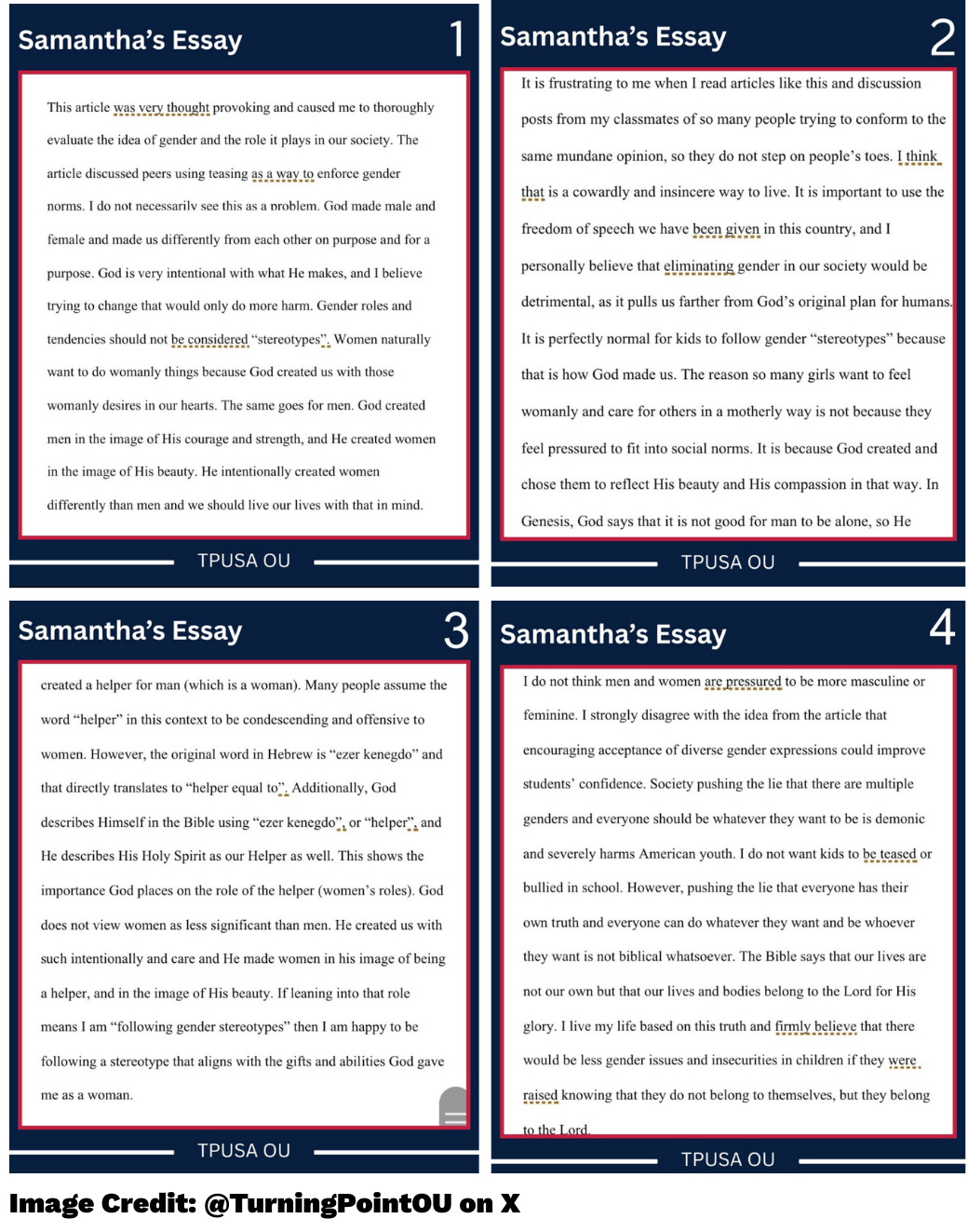
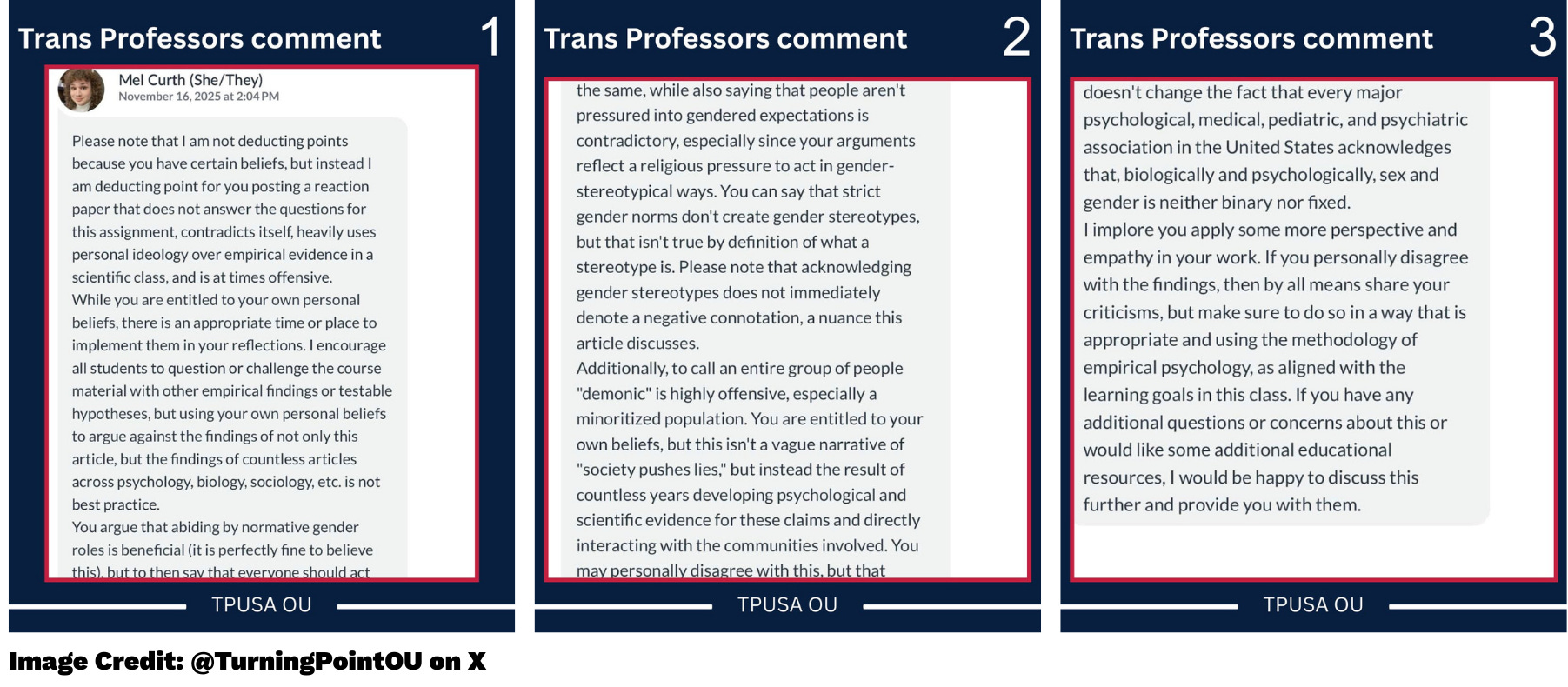
Curth provided detailed feedback explaining that Fulnecky’s paper received zero points due to its failure to answer the prompt, its internal contradictions, and its reliance on personal ideology over the empirical evidence required in a science-based course.
Curth’s feedback:
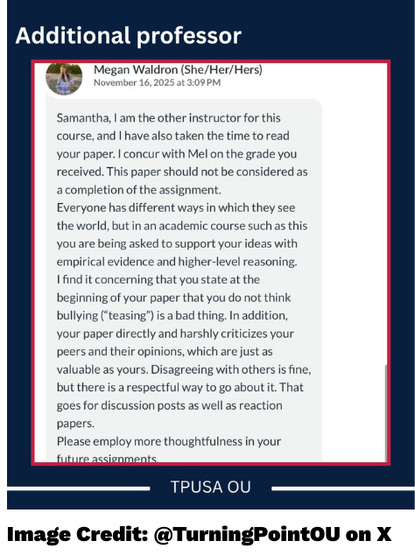
This was followed by a grade appeal, where the failing grade was supported by a second professor:
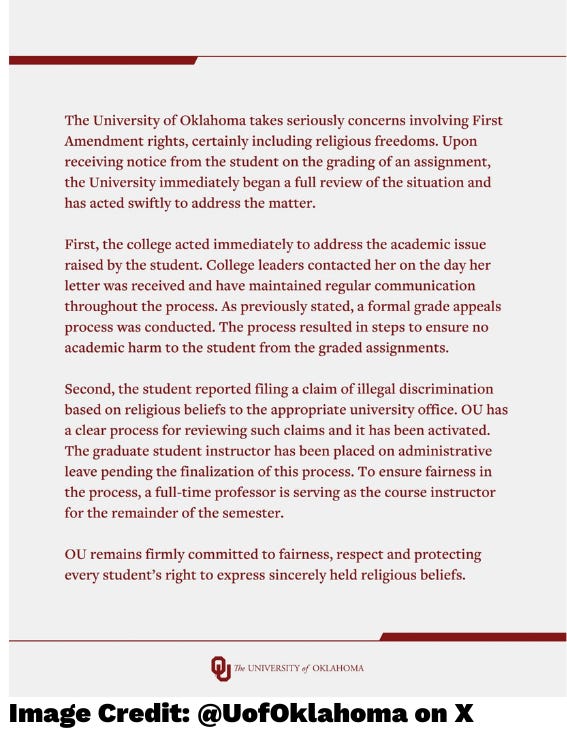
As of the time I published this, Curth has been placed on administrative leave while Fulnecky’s claim of illegal discrimination based on religious beliefs is investigated
The University of Oklahoma’s statement:
What should have been (and would have been until quite recently) an internal university process is now the center of a viral tweetstorm, reflecting a disturbing pattern I’ve seen in my work as a crisis communications and reputation management consultant with a special interest in supporting academics. Routine academic interactions (grade disputes, classroom discussions, syllabus contents, social media comments etc.) are being taken out of context, amplified by a powerful outrage machine, and transformed into firestorms, requiring universities and faculty to prepare for how to respond when academic judgment and political warfare collide.
Not worried about the risk? Have a look at Turning Point USA’s Professor Watchlist and some of the effects that has had…
The Breakdown
Every crisis has a lifecycle, and we need to understand the stages to manage it. The grade appeal and discrimination complaint were at the warning stage, at which point the issue was contained within the university’s established channels for academic disputes. It shifted into the acute stage when the student and Turning Point USA made the matter public on X. Within 48 hours, the story was picked up by national conservative media outlets such as the New York Post and the Daily Mail. At this point, the university had lost control of the narrative. Two competing frames were established, creating a narrative warfare.
Narrative A: Religious discrimination & free speech violation
Protagonist: A Christian student punished for her faith
Antagonist: A “transgender professor” imposing ideology
Conflict: An attack on First Amendment rights
Evidence: The failing grade and the instructor’s identity
Narrative B: Failure to meet academic standards
Protagonist: A professional educator upholding academic integrity
Antagonist: A student and political group manufacturing a controversy
Conflict: A failure to follow assignment instructions
Evidence: The essay’s content and the instructor’s detailed feedback
The immediate and effective framing by Turning Point USA in Narrative A is a hallmark of modern political crises. They did not argue the paper’s academic merits; they created a more emotionally resonant and politically potent narrative of persecution. Most of the discourse happened on X, characterized by extreme polarization, high velocity, and targeted harassment, with Narrative A dominating the discourse as users categorized the issue as religious discrimination… as a result of Turning Point USA and affiliates pushing this narrative. They focused on Curth’s transgender identity and framed the university as a taxpayer-funded institution suppressing Christian values. Unsurprisingly, given the current political climate, this successfully mobilized a national audience.
Curth became the focal point of a vicious harassment campaign that went substantially beyond criticism of their grading, including dehumanizing language, deadnaming, and doxxing.
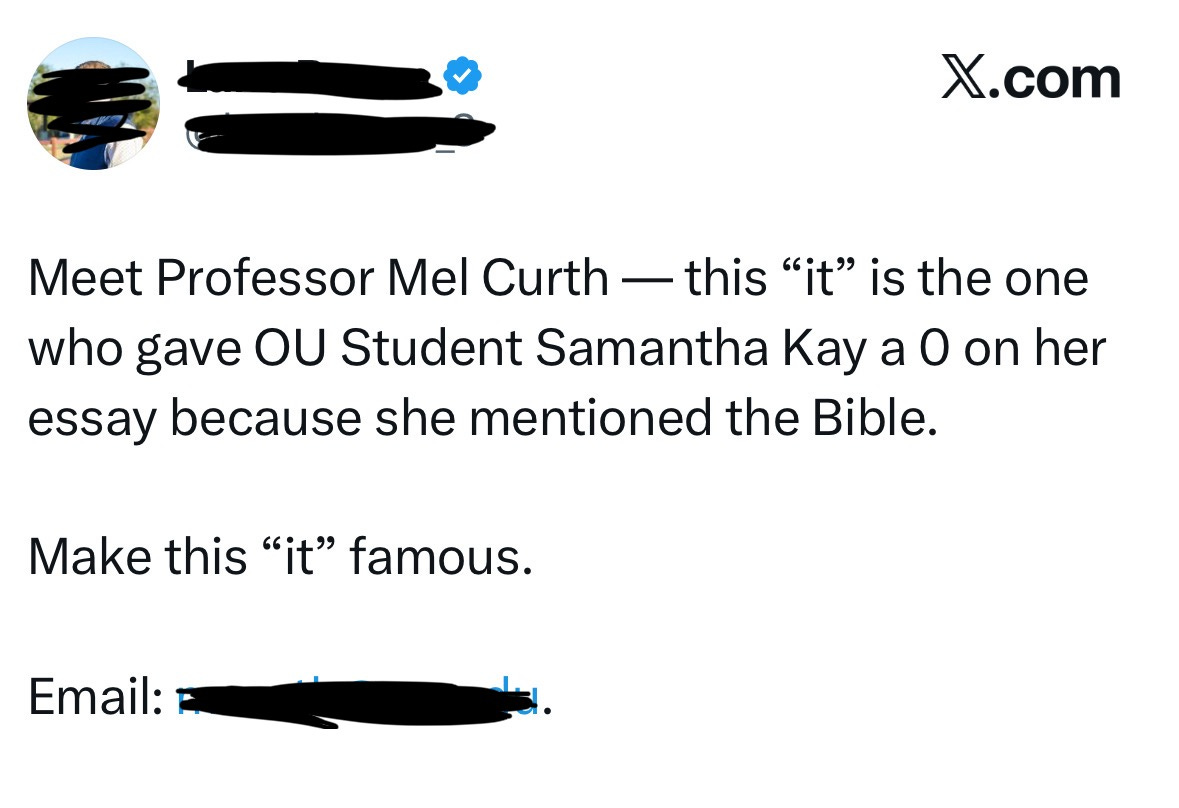
This tactic is designed to intimidate, silence, and punish academics who do not conform to a specific political ideology, creating a chilling effect for other educators.
Most discussion on X lacked nuance, with commenters firmly entrenched in one of two narrative camps, although reader comments in The Oklahoman showed a more balanced and thoughtful discussion. Many readers, including self-identified Christians, sided with the instructor, noting the essay’s poor academic quality and its failure to adhere to the assignment’s instructions. This difference illustrates the contrast between the hyper-partisan environment of X and more traditional forums for public discourse.
The University’s Response
The University of Oklahoma’s November 30 statement demonstrates a clear attempt to convey a neutral and process-oriented tone, mentioning the university’s commitment to First Amendment rights and fairness and noting that a “formal grade appeals process was conducted.” This is a classic diminish strategy (reducing the perceived severity of the issue). However, the announcement that the “graduate student instructor has been placed on administrative leave” and replaced by a “full-time professor” creates a significant messaging disconnect that undermines the the rhetoric of fairness. This action appears to validate Fulnecky’s complaint and hold Curth responsible before the conclusion of formal investigations. From a crisis comms perspective, this kind of mixed messaging is a critical error.
Critics on the right see it as an admission of guilt. Faculty and supporters of academic freedom are alienated, seeing it as capitulation to a political mob.
The university also released their statement too late, letting Turning Point USA lead with the religious discrimination narrative, which is now firmly entrenched in public consciousness.
Why academics are increasingly at risk
This case is not an isolated incident but a symptom of a broader political strategy to undermine higher education and enforce ideological conformity. Several factors contribute to this rising risk for faculty:
Organizations like Turning Point USA are exceptionally adept at manufacturing outrage. They identify a local incident, frame it in a politically charged narrative, and leverage their national network to generate a media firestorm and political pressure.
Contingent faculty lack job security. It’s no coincidence that the target in this case was a graduate student instructor. Graduate students, adjuncts, and lecturers often lack the institutional support and union protections that tenured professors have, making them easier targets.
Identity is weaponized. The relentless focus on the instructor’s transgender identity was a deliberate strategic choice that taps into pre-existing “culture war” narratives that position individuals’ minority status to fuel outrage and delegitimize their professional judgment.
So, what if you’re the target?
Finding yourself at the center of a campaign like this is a terrifying and isolating experience, but there are steps you can take to protect yourself, both emotionally and professionally.
The First 24 Hours: Emotional regulation
The moment you become aware that you are a target, your first priority is to manage your own emotional response. You will feel shock, anger, and fear. These are normal reactions, but acting on them can be disastrous.
Do NOT Respond Publicly! Your first instinct will be to defend yourself. Resist it. Engaging with trolls on social media or trying to explain your side of the story in a public forum will only add fuel to the fire. You cannot win a debate with a mob.
Make your personal social media accounts private and remove any publicly available personal information to reduce the surface area for harassment.
Step away from the computer. Talk to a trusted friend, partner, therapist, or engage with a professional resource. Do not doomscroll through the hateful comments.
(I have an “Emotional Mastery Framework” available (free!) on my website to help with the initial emotional storm that comes with situations like this)
What’s next? Your action plan
Once you have taken steps to protect your emotional well-being, you can move on to a strategic response.
Document everything. Compile a file with the original assignment instructions, the student’s work, your feedback, and any email correspondence. A clear paper trail is your best defense.
Immediately inform your department chair and dean. Provide them with your documentation. All communication with the administration should be through official channels.
If you are represented by a union, contact them immediately. This is precisely the kind of situation they exist to handle.
Do not issue your own public statements. The university has a communications department for this purpose. What you do need to do is provide the comms people with the facts so they can respond accurately.
A call to action for university leaders
Now is not the time to take a reactive “we’ll deal with it if it happens to us” approach. It’s important to proactively prepare for these inevitable attacks and to develop rapid-response protocols for when your faculty/staff become targets of online harassment. How to respond effectively in a situation like this isn’t something you should be learning how to do when it happens.
Develop a rapid response protocol for online harassment
Universities need a clear, pre-approved plan for what to do when a faculty member is targeted. This plan should include IT support for securing accounts, communications support for managing media inquiries, and mental health support for the targeted individual. The protocol should be activated immediately upon notification, not after days of deliberation. Every hour of delay allows the attackers to entrench their narrative further and escalate the harassment.
This protocol should include a designated crisis communications team with authority to act quickly, a pre-drafted statement template that can be customized to specific situations, and a clear chain of command so that no one is left wondering who has the authority to speak on behalf of the institution. The University of Oklahoma’s delay in issuing a formal response was a critical error that allowed Turning Point USA to dominate the narrative space completely.
Publicly and unequivocally defend academic freedom
The default institutional response must be a robust defense of the faculty’s right and responsibility to grade students according to academic merit. The University of Oklahoma’s statement mentioned religious freedom but omitted academic freedom. This creates the impression that the university views the student’s religious freedom claim as more legitimate than the instructor’s professional judgment.
A more effective statement would explicitly affirm that faculty have the authority and responsibility to assess student work against clearly articulated academic standards, and that disagreement with a grade does not constitute discrimination. It would have noted that the university has established processes for grade appeals precisely to ensure fairness, and that these processes were being followed. Most importantly, it would have made clear that the university does not tolerate harassment of its employees and that it stands behind faculty who are doing their jobs in good faith.
Don’t isolate the target… support them!
Placing an instructor on administrative leave should be a last resort, not a first response. It signals guilt and abandons the employee at their moment of greatest need. The university should stand behind its employees until a thorough and fair investigation, conducted in accordance with established procedures, proves wrongdoing.
In this case, the decision to remove Curth from the classroom and replace them with a full-time professor sent a devastating message to faculty across the institution and beyond. It communicated that if you become the target of a political campaign, the university will sacrifice you to appease the mob. This type of action creates a chilling effect where instructors, particularly those who are already vulnerable due to their contingent employment status or minority identities, might opt to self-censor and avoid any topic or grading decision that might provoke controversy.
A better approach would have been to keep the instructor in place while the investigation process ran its course, with additional support from the department and administration. If there were legitimate safety concerns, those should have been addressed through increased security measures, not by removing the instructor and implicitly validating the harassment campaign.
Invest in media and crisis training for academic leaders
Deans and department chairs are on the front lines of these crises. They need to be trained to communicate effectively under pressure and to support their faculty during these attacks. This training should cover the basics of crisis communication, including the importance of speed, consistency, and message discipline. It should also address the unique challenges of social media crises, where traditional communication strategies may be ineffective or even counterproductive.
Leaders should understand that their primary audience in these situations is not the online mob, but rather their own faculty, students, and stakeholders who care about the institution’s integrity. They should be trained to resist the temptation to appease critics acting in bad faith, and instead focus on communicating clearly and consistently with those who share the institution’s values.
Create a legal defense fund and provide access to counsel
Faculty who are targeted in these campaigns may face not only professional consequences but also legal threats. This appears to be a specific risk in this case as the student’s mother is an attorney specializing in, among other things, constitutional law and civil rights violations; while not licensed to practice in Oklahoma, she will most likely have strong connections with those who are.
Universities should establish a legal defense fund and ensure that targeted faculty have immediate access to legal counsel. This is particularly important for contingent faculty who may not have the resources to defend themselves against frivolous lawsuits or formal complaints.
Build coalitions with other institutions
No single university can effectively counter these coordinated national campaigns on its own. Universities must work together to develop shared best practices, coordinate their responses, and present a united front in defense of academic freedom. Professional organizations like the American Association of University Professors (AAUP) can play a crucial role in facilitating this coordination.
Academic freedom is at risk
What happened at the University of Oklahoma is an example of the risks of the current convergence of academia and political discourse. Can universities maintain their core mission of pursuing truth through rigorous inquiry? Or will be transformed into ideological battlegrounds where academic decisions are subject to political veto…
The tactics used here by Turning Point USA, taking a private academic matter public, framing it in inflammatory terms, mobilizing a harassment campaign, and pressuring the institution to take punitive action, are NOT new. These approaches have been used successfully against faculty across the country, particularly those who teach on topics related to race, gender, sexuality, or other subjects that have become politically charged.
Every time a university capitulates to these tactics, it becomes easier for the next campaign to succeed.
The stakes are particularly high for faculty who are members of marginalized groups. As we saw in this case, the instructor’s transgender identity was not incidental to the controversy; it was central to how the story was framed and amplified. This creates a double bind for minority faculty: they are both more likely to be targeted and less likely to receive institutional support when they are attacked.
For those of us who work in crisis communications and reputation management, these cases present unique challenges because our instinct is often to de-escalate, find common ground, and satisfy as many stakeholders as possible… but when one of the stakeholders is a well-funded political organization whose goal is not resolution but rather the creation of a spectacle, traditional crisis management strategies may be insufficient or even counterproductive.
We need to get creative and be prepared because we can’t avoid controversy. And self-censorship is NOT the answer.
Faculty need to know that they will be supported when they make difficult but defensible academic decisions. Universities need the courage to stand behind their values, even when it is politically costly.
And all of us who care about higher education need to recognize that these attacks are not isolated incidents but part of a coordinated effort to reshape the academy in a particular ideological image.
This incident is a stark reminder that academia is not insulated from rising political tensions.
For universities to fulfill their mission, they must be prepared to defend not only their reputation but also the people who keep it running. The safety, security, and academic freedom of every faculty member depends on it.
References
Coombs, W. T. (2007). Ongoing Crisis Communication: Planning, Managing, and Responding. SAGE Publications
Fink, S. (1986). Crisis Management: Planning for the Inevitable. AMACOM
Kahan, Dan M. (2017). Misconceptions, Misinformation, and the Logic of Identity-Protective Cognition. Yale Law School, Public Law Research Paper No. 605
McPherson, Molly. (20250 Indestructible PR Playbook.
LLCMochon, Daniel, and Janet Schwartz (2024) The Confrontation Effect: When Users Engage More with Ideology-Inconsistent Content Online. Organizational Behavior and Human Decision Processes, vol. 185