
If I have to spend one more minute in this meeting, I'm going to impale everyone with a straw

Stuck in a tedious, seemingly unnecessary meeting with no end in sight, one attendee posts a fleeting expression of exasperation intended for a small circle of online friends:
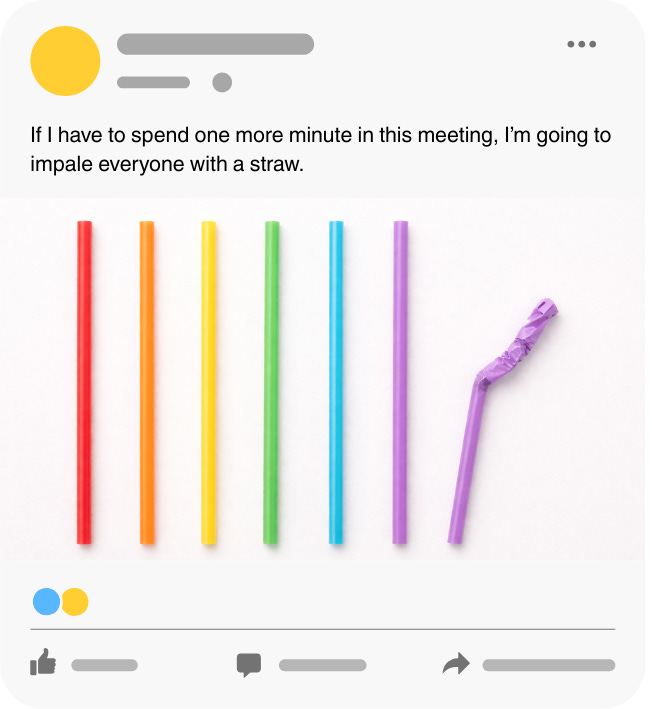
However, as online posts have a tendency to do, it circulates beyond that small circle and ends up on the screen of another meeting attendee. She shares it with the colleague sitting next to her. And he shares it with the next… Suddenly, everyone in attendance has seen it. One colleague, feeling alarmed and perhaps offended by the implication in the message, prints the post off and sends it to the poster’s boss with a note expressing concern that their team member is making violent threats against the team.
The poster is now facing a formal complaint. They think it’s ridiculous. It is obviously not a serious threat, and it was never intended to be seen by anyone else in the group. Their immediate reaction to the complaint might be to defend against the most serious accusation, that they are a physical threat… but is that the primary concern here?
Beyond the joke
The underlying message our poster’s colleagues received has very little to do with the fear of being impaled with a straw (though they should perhaps take a cup with an alternative lid to future meetings, just in case). It’s also unlikely that any of their colleagues genuinely believes this person to be a physical threat. The post itself is easily dismissed as hyperbole and not literal. The sentiment behind it, though? That creates a more of a lasting impression. What “If I have to spend one more minute in this meeting, I’m going to impale everyone with a straw” is really saying (whether intentionally or not) is:
I’m not invested. The post is a clear indicator of disinterest. It tells the team, “I don’t want to be here.” This is a damning admission in a professional environment (yes, even if most of the people in the room don’t actually want to be there).
I don’t consider myself part of the team. The post creates an implicit “us vs. them” dynamic, with the poster positioning themselves outside of and against the group. It undermines the sense of shared purpose and mutual respect that groups typically expect.
I don’t respect you. The post publicly signals that the poster believes their own time is more valuable than that of their colleagues and their institution.
This is the reputational crisis.
Reputation is currency and the foundation upon which professional trust is built. Our poster might think it ridiculous, again, that their colleagues would form a negative opinion of them according to this one throwaway online comment, but while reputations are built through consistent, positive actions over many years, a single misstep (especially an online one, given how quickly posts get spread around and the lack of control we have regarding where they end up) can jeopardize them instantly. The issue is not the potential for straw-related violence but being seen as a disengaged and adversarial colleague. If not addressed, perceptions like this can ‘stick’ long-term and create barriers to collaboration and trust.
Three common mistakes
It’s human nature to get defensive when something we’ve said gets blown out of proportion and taken out of context. However, giving in to that defensiveness and using it as a strategy to ‘fix’ the situation… won’t produce the desired effect (unless you want to dig a deeper hole, in which case this article might not be for you). There are three common mistakes that people make in situations like this. Understanding what they are can help you avoid them if you end up with a similar issue.
Focusing on the wrong issue. In this case, the poster’s immediate defense might be to address the alarming accusation and to rush to reassure everyone that the post was a joke, they’re not going to stab anyone with a straw. This clarification is necessary. However! Focusing on it as the primary issue is a critical error because doing so is essentially responding to the symptom, not the disease. Focusing on the literal meaning of the words misses the opportunity to address the underlying perceptions of disrespect and disengagement that are causing the real harm. The colleagues are not worried about straws; they’re concerned about the poster’s attitude toward them and their shared work. A defense that ignores this fundamental concern will be perceived as obtuse at best, and dismissive at worst.
Shifting the blame. The poster will likely be tempted to blame their colleagues for their negative perception. This is an extremely common reaction (and understandable, from a human nature perspective—you’re not wrong to feel defensive in this way, it’s just rarely productive). The poster might be thinking, “I’m a great colleague, I always help out, and now they think I’m a terrible person because of one stupid post? That’s their fault for misinterpreting me!” And listen, I get it… as someone who has been misinterpreted (haven’t we all?), I get the unfairness of it all. But showing this sentiment is a little bit like gaslighting as its telling the affected parties that their feelings are invalid, and nobody enjoys being gaslit. It won’t rebuild trust. The reality is that, regardless of intent, fairness, or the accuracy of the perception, the poster’s action caused their colleagues’ negative feelings. Regardless of past behavior, the post created a new negative context through which other actions may be viewed. Shifting the blame is a defensive posture that prevents the poster from taking ownership of the situation, which is an absolute prerequisite for rebuilding trust.
Focusing on shared sentiment. The poster may be thinking, “But half the people in that room were bored out of their minds! I just said what everyone was thinking!” However, there’s a massive difference between thinking something and saying it publicly. There’s even a massive difference between saying something to one trusted colleague and saying it publicly. Social contracts in the workplace (no matter how much we may dislike them) often require us to maintain a public display of engagedness (is that a word? Perhaps not, but it’s clear enough, so IDC). Violating that contract makes you appear untrustworthy (yes, even if it’s your authentic and transparent view…). Even if a colleague in the room shared the poster’s sentiment, being confronted with it publicly is a different experience. If the poster shared an “I hate this group” message with their colleague directly in a 1-1 private message, it would come with an implicit “but not you” meaning; a shared understanding that the frustration is with the meeting, and not the recipient of the message. A public post lacks this nuance entirely. Trusted colleagues who might have shared the poster’s sentiment are now left wondering, “Do they dislike me, too?”
A note on viral risk
The scenario above was contained within a single department (though it could be considered to have ‘gone viral’ within it). It is not a hypothetical situation. Although I have changed the details substantially and can’t share the ‘real’ ones, I can share that because of the nature of the institution and individuals involved, if it had ended up on a platform like X in the current political climate, it could easily have resulted in the poster being doxxed and their institution being dragged through a mess of a ‘court of public opinion’ with everything taken out of context and a complete loss of narrative control. The poster would have faced a mob of strangers pulling apart their character and professional history, and the institution might have been pressured to act, with negative consequences for the poster’s career. These situations can have very real consequences, such as permanent digital footprints and employment termination. A thoughtful and strategic response is even more important in an internet outrage situation.
The fix
Repairing your reputation after doing something that damages others’ trust in you (whether you perceive that damage to be fair or not) is not a quick or easy process. It requires accountability, awareness, and a demonstrated, long-term commitment to addressing the negative perceptions and showing that they don’t really apply to you. It takes more than words. Actions are needed as well. But the right words are a great starting point. So what could our poster do here?
Fully assess the situation. Addressing the underlying implications of their post and the perceptions their colleagues have as a result of it requires awareness of what those perceptions are. If you’re in a situation where you’ve been accused of something or something you’ve said has been taken out of context, it’s important to take a step back and look beyond your own perception to understand what others might be thinking and why.
Take accountability. The first and most critical step is to offer a sincere, unqualified apology to their boss and those present at the meeting. No excuses, justifications, or phrases like “I’m sorry if you were offended” or “I’m sorry, but I was just frustrated” (those are shifting blame). A true apology takes full ownership: “I am deeply sorry for the message I posted during the meeting. It was unprofessional, disrespectful, and a serious lapse in judgment. There is no excuse for my behavior.”
Acknowledge the impact. After owning the action, the poster must demonstrate understanding of the real harm they caused. This is where they move beyond the literal threat and address the underlying issues of respect and engagement. The apology should continue with something like: “I understand that my post was a sign of disrespect to all of you and to the work we are doing together. It sent the message that I don’t value your time, that I’m not engaged in my role, and that I don’t want to be part of this team. I want to assure you that this is not the case. I am committed to my job, and I have a great deal of respect for all of you as my colleagues.” This provides important validation of the colleagues’ feelings and shows that the poster has the self-awareness to understand the true nature of their mistake. [Note: Many people have a strong negative reaction to having to do this type of thing… you may feel like you’re taking responsibility for things that aren’t your fault, that you’re making yourself look bad to appease others, that it’s unfair, annoying etc… Those feelings are normal, and it’s important to work through them to produce an authentic response.]
Recommit and demonstrate change. As I said above, words aren’t enough. The final step is to consistently demonstrate the qualities that the post called into question. The poster must make a conscious, visible effort to be more engaged, more respectful, and more committed. This means putting the phone away during meetings, asking thoughtful questions, actively participating in discussions, offering to help colleagues, and generally projecting an attitude of positivity and collaboration. Not being fake, but making a genuine effort to live up to the professional standards that were perceived to be violated. Over time, these consistent actions will speak louder than the single, foolish post. They will form a new body of evidence that will gradually overwrite the negative impression and rebuild the foundation of trust.
The takeaway
Our words can have unexpected and unintended consequences, and the most significant impact of a misstep may not always be the most obvious one. Understanding the true nature of reputational damage, avoiding the common pitfalls of a defensive response, and following a disciplined path of ownership, acknowledgment, and demonstrated change can recover your reputation, even when you make a serious professional mistake. It’s not easy, and it humility and perseverance… but if you’re willing to do the work, you can repair your reputation and gain a deeper understanding of how you might come across to help you avoid similar problems in the future.